Entrepreneur Training That Moves Participants From Learning to Implementation
How To Business helps early-stage entrepreneurs connect customer discovery, marketing, sales, customer experience, and business systems so they can build a complete customer journey and a practical implementation plan.
15–20 minute exploratory call
The Problem
Entrepreneurs are often taught marketing, sales, customer discovery, websites, technology, and operations as separate subjects. They may complete classes, workshops, and cohorts with more information but still struggle to understand how those pieces should work together inside their own business.
They understand individual business concepts but do not see the complete customer journey.
They may attract interest but have no clear process for following up.
They buy tools and technology before defining the process those tools should support.
They struggle to identify where potential customers stop moving forward.
They leave business programs with information but no practical implementation plan.
Without a connected process, promising business ideas can remain unclear, inconsistent, and difficult to implement.
Who This Pilot Is Designed For
Student Entrepreneurs
Students developing a business, side business, product, service, or early-stage venture.
Entrepreneurship Cohorts
Participants enrolled in entrepreneurship, small-business, or venture-development programs.
Incubator Participants
Founders who are testing an idea, validating a market, or preparing to launch.
Early-Stage Founders
Entrepreneurs who have started but do not yet have a clear customer journey or operating process.
Entrepreneur-Support Programs
Organizations that want participants to move from business education to practical implementation.
Three-Session Pilot Structure
The recommended pilot is delivered across three facilitated sessions, approximately two hours per session.
Session 1 - Customer Clarity and Assumption Testing
Participants define who the business is designed to serve, the problem the customer is trying to solve, what caused the customer to take action, what they have already tried, and what result they want.
(90 minutes)
Participants complete:
Ideal Client Survey
Customer problem statement
Assumption review
AI-supported customer summary
One customer-research action
Output: Prioritized pain points and opportunities
Session 2 - Journey Diagnosis and Mapping
Participants examine how customers currently move through the business and identify where the journey may be incomplete, unclear, or inconsistent.
(90 minutes)
Participants complete:
Customer Journey Diagnostic
Discovery and follow-up review
Three-phase customer journey map
Identification of missing steps
Top journey gaps and opportunities
Output: Simple implementation plan and success metrics
Session 3 - Systems and Implementation Planning
Participants determine what processes, systems, and tools are needed to support the journey and create a practical implementation plan.
(60-90 minutes)
Participants complete:
Priority gap review
Process and system recommendations
Tool-selection considerations
30-day implementation plan
Defined next steps
Output: Pilot launch checklist and communication plan
TANGIBLE DELIVERABLES
What Participants Leave With
A clearly defined customer and business problem
A completed customer journey map
Identified gaps and missed opportunities
A clearer understanding of how customers move through the business
Recommended systems, tools, or manual processes to evaluate
A prioritized 30-day implementation plan
Clear next steps that can be used immediately
A list of assumptions that still require customer validation
Participants do not leave with information alone. They leave with completed business tools and a practical path forward.
OPTIONAL NEXT STEPS
Follow-Up Support
Ensure sustained momentum after the pilot. We offer dedicated coaching, ongoing implementation advisory, and roadmap reviews to guarantee your long-term success.
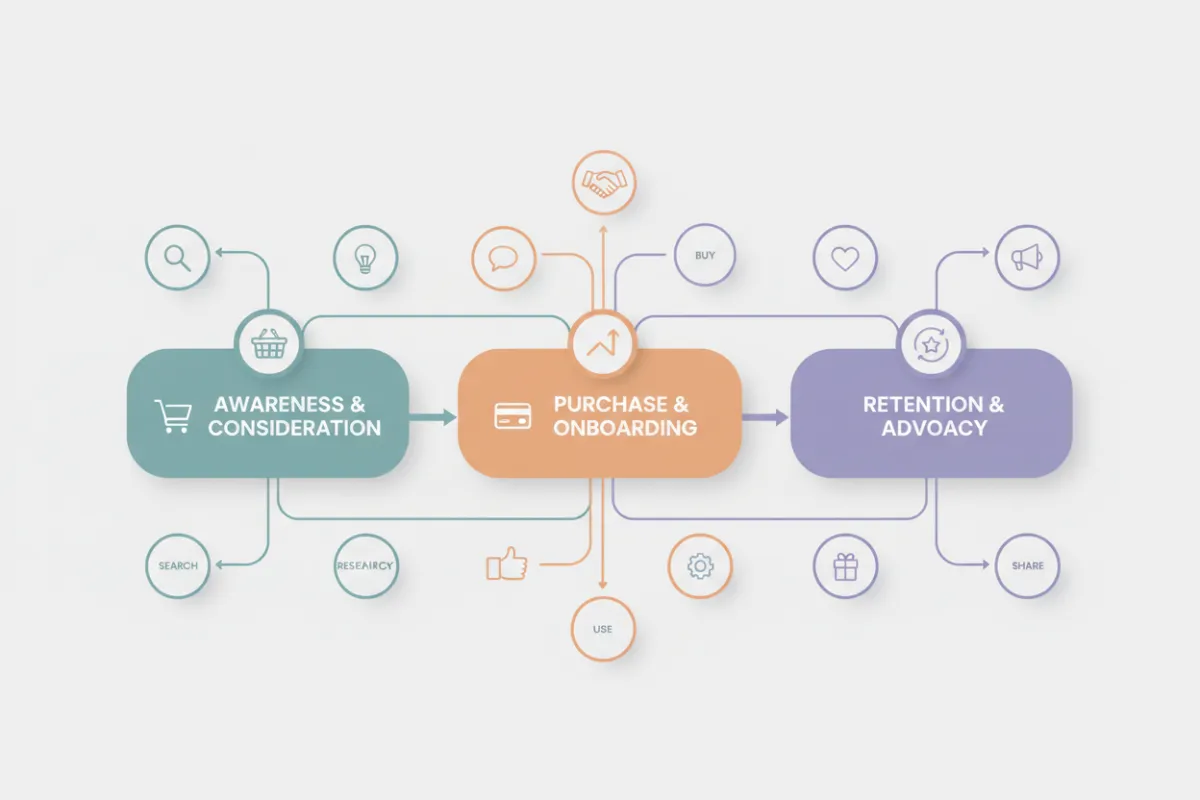
A guided framework that moves from customer clarity to journey mapping and implementation.
METHODOLOGY
The Customer Journey Framework
The framework helps participants connect ten stages of the customer experience across three practical phases.
Phase 1: Collect the Leads
Target
Attract
Capture
Engage
Participants define who they are trying to reach, how those people discover the business, how interest is captured, and how the relationship is developed.
Phase 2: Convert the Clients
Offer
Close
Deliver
Participants clarify where and how the offer is presented, how interested people make a decision, and how the product or service is delivered.
Phase 3: Create the Fans
Impress
Multiply
Retention
Participants identify how the business strengthens the customer experience, encourages referrals or advocacy, and creates opportunities for repeat business.
How It Complements Existing Entrepreneurship Education
The Customer Journey Diagnostic and Implementation Program is not designed to replace customer discovery, marketing, finance, business modeling, or operations education.
It helps participants connect those subjects and apply them to one real or proposed venture.
Existing Entrepreneurship Education May Teach
Customer discovery
Marketing
Sales
Business models
Operations
Customer service
Technology
Growth strategy
This Program Helps Participants
Connect those topics into one customer journey
Apply the concepts to their own business
Identify missing or weak stages
Separate known facts from assumptions
Prioritize what should be improved first
Create a practical implementation plan
This program serves as a practical bridge between introductory entrepreneurship education and customer-centered implementation.
PARTNERSHIP MODELS
Flexible Training and Partnership Options
Guest Classroom Lab
A focused 60- to 90-minute session introducing the framework and completing one diagnostic component.
Customer Journey Workshop
A two- to three-hour working session where participants diagnose key journey gaps and begin mapping the customer experience.
Three-Session Pilot
A complete training series covering customer clarity, journey diagnosis, mapping, systems, and implementation planning.
Cohort or Program Integration
A customized version incorporated into an existing entrepreneurship course, incubator, accelerator, or cohort.
Train-the-Trainer Certification
Equip your internal faculty, program managers, and directors to independently and confidently deliver the curriculum.
Contact for pricing
Ongoing Advisory & Support
Continuous strategic support, program integration guidance, and curriculum refinement customized for your administrative team.
Contact for pricing
Final scope, schedule, participant capacity, assessment requirements, and customization are determined in partnership with the host organization.

Why How To Business
ERIN RANDLE
FOUNDER, How To business
Business Strategy & Systems Advisor
Erin Randle-Green helps entrepreneurs simplify complex business decisions, strengthen customer journeys, and build systems that support sustainable growth.
Before becoming a business advisor, Erin owned and operated a photography studio for seven years. That experience gives her a practical understanding of what happens when someone develops a valuable professional skill but still needs to learn how to build the business around it.
Through coaching, workshops, cohorts, and entrepreneur-support programs, she has supported more than 50 entrepreneurs in clarifying their businesses and identifying practical next steps.
Founder of How To Business
Creator of the Customer Journey Ecosystem
Supported more than 50 entrepreneurs through coaching and training
Former seven-year small-business owner
Business coach and service provider with Sunshine Enterprises
City of Chicago M/WBE Certified
Experienced workshop facilitator and entrepreneur educator

EVALUATION METHODOLOGY
Built for Practical Learning and Measurable Completion
The program is structured around completed participant artifacts, not attendance alone.
Depending on the engagement, pilot evaluation may include:
Pre- and post-program clarity assessments
Participant artifact-completion rates
Completed customer journey maps
Identified journey gaps
Implementation-plan completion
Participant usefulness ratings
Facilitator observations
30-day implementation follow-up
The Customer Journey Diagnostic and Implementation Program is a practitioner-developed, pilot-ready framework. Initial institutional pilots are designed to measure participant clarity, completion, identified gaps, and implementation activity.

Review the University Pilot Overview
Download the one-page overview for a concise explanation of the program, intended audience, three-session structure, participant deliverables, and institutional partnership options.
Format: PDF | Length: ~2 pages | Updated: July 2026
Discuss a University or Cohort Pilot
Frequently Asked Questions
Is this program only for university students?
No. The program can also be delivered through incubators, accelerators, nonprofit cohorts, community-based entrepreneurship programs, and organizations supporting early-stage founders.
Does this replace customer discovery or business planning instruction?
No. The program complements existing entrepreneurship education by helping participants connect and apply what they are already learning.
Does every participant need an existing business?
Participants should have a business idea, product, service, professional skill, side business, or early-stage venture to apply the framework to. They do not need an incorporated business or existing revenue.
Is the training available virtually?
Yes. The program can be delivered in person, live virtually, or through a hybrid format, depending on the organization and participant needs.
Does the program use AI?
AI may be used as a structured decision-support tool to organize participant responses, identify unclear assumptions, and support implementation planning. Participants remain responsible for reviewing and approving their final decisions.
Can the program be customized?
Yes. The length, examples, activities, delivery format, assessment requirements, and participant materials can be adjusted to complement the host organization’s existing program.
Is one-on-one advising available?
One-on-one advising or an implementation clinic can be included as an optional extension of a training engagement.
How do we begin?
Schedule a short conversation to discuss your participants, current program, desired outcomes, schedule, and the most appropriate training format.
Help Your Participants Move From Business Education to Implementation
Let’s discuss how the Customer Journey Diagnostic and Implementation Program could support your students, founders, or cohort participants.
CONTACT
[email protected]
+1 (838) 444-5646
© 2026 How To Business University Pilot Program. All rights reserved.